Pennsylvania regulators will investigate proposed water and wastewater rate increases from Reynolds Water Company and Reynolds Disposal Company after a unanimous September 10 vote. The Pennsylvania Public Utility Commission announcement suspends the requested increases while the cases are examined. Customers should not read the proposal amounts as rates already approved for their bills.
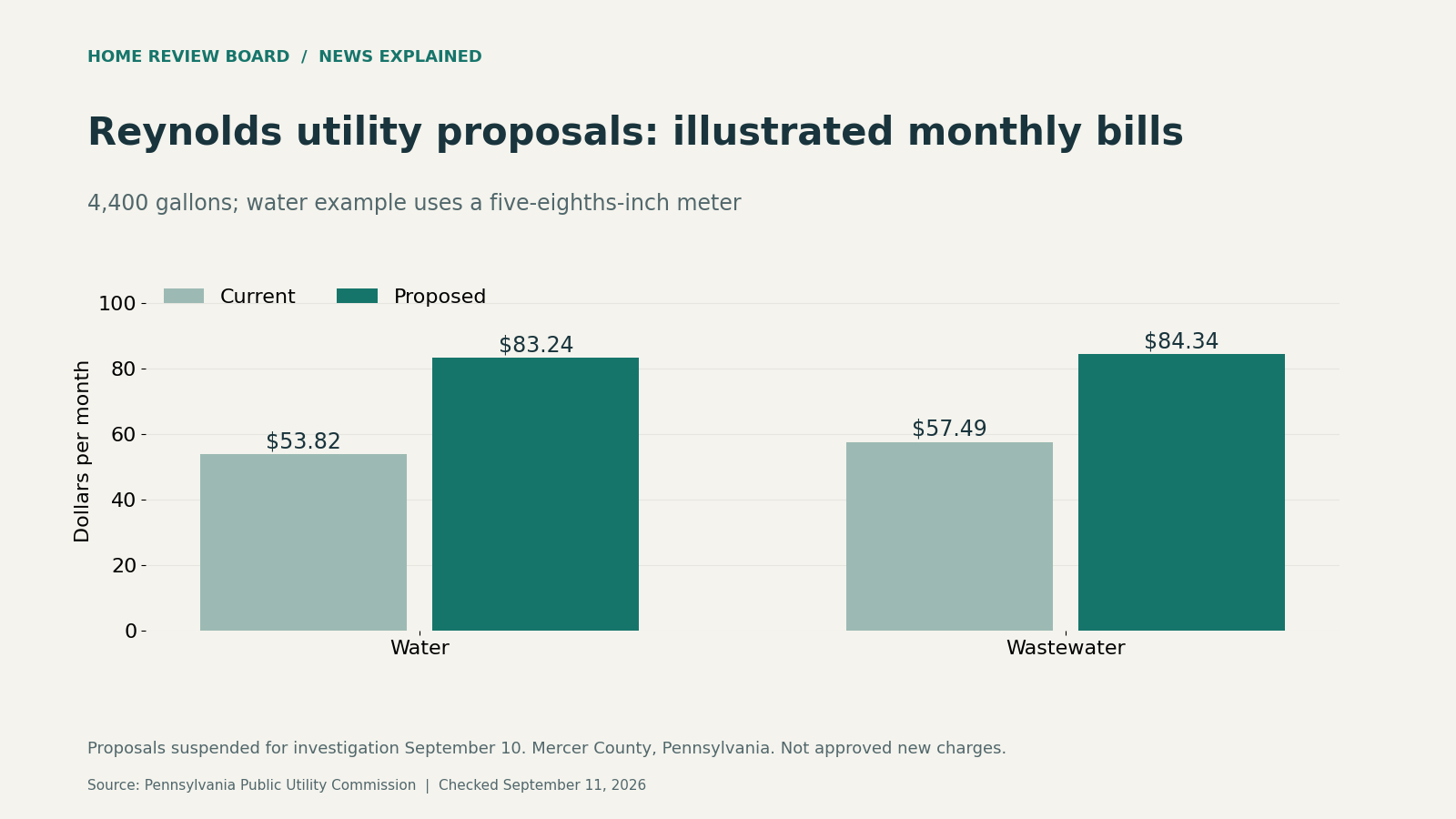
The companies serve parts of Pymatuning, Delaware and Hempfield townships in Mercer County, Pennsylvania. The illustrated monthly water bill for 4,400 gallons and a five-eighths-inch meter would rise from $53.82 to $83.24. The wastewater example would rise from $57.49 to $84.34. A final decision is due by April 29, 2027.
The geography matters. This is a western Pennsylvania utility proceeding, not a notice for the Greenville-Anderson-Greer metropolitan area in South Carolina. Even within Mercer County, customers need to check the supplier on their account rather than assume every water system is involved.
Read the proposal with your own bill
An illustrated bill makes the size of a request understandable, but it is not an individualized calculation. Compare the example’s usage and meter assumptions with your statement. If they differ, ask the utility or commission how the proposed tariff would apply to your account.
Keep the current tariff separate from the requested one. The review may result in an outcome different from the application, and the timetable gives no reason to change a payment based solely on a news article. Use the bill actually issued and seek clarification through the utility when something appears inconsistent.
For residents who want to participate, the commission’s announcement is the route to the proceedings and subsequent public-input information. Check the instructions attached to any hearing or comment opportunity rather than assuming that an ordinary customer-service complaint becomes part of the regulatory record.
A plumbing visit answers a different question
A plumber may help investigate unusually high consumption or a documented system problem. The rate request alone is not evidence of a leak. Before arranging diagnostic work, distinguish a change in gallons used from a change in the price charged for those gallons.
Service businesses should be equally specific. A repair proposal should explain the observed condition and work required, without implying that hiring the company can change the utility’s approved tariff. The immediate next step is to identify the provider, preserve the current bill and follow the commission’s review of the requested rates.
Further reading
Finding hidden water leaks and How many contractor estimates.
Sources
Home Review Board publishes practical guides and source-grounded news. Project requirements depend on the property and location. Read our research approach.