
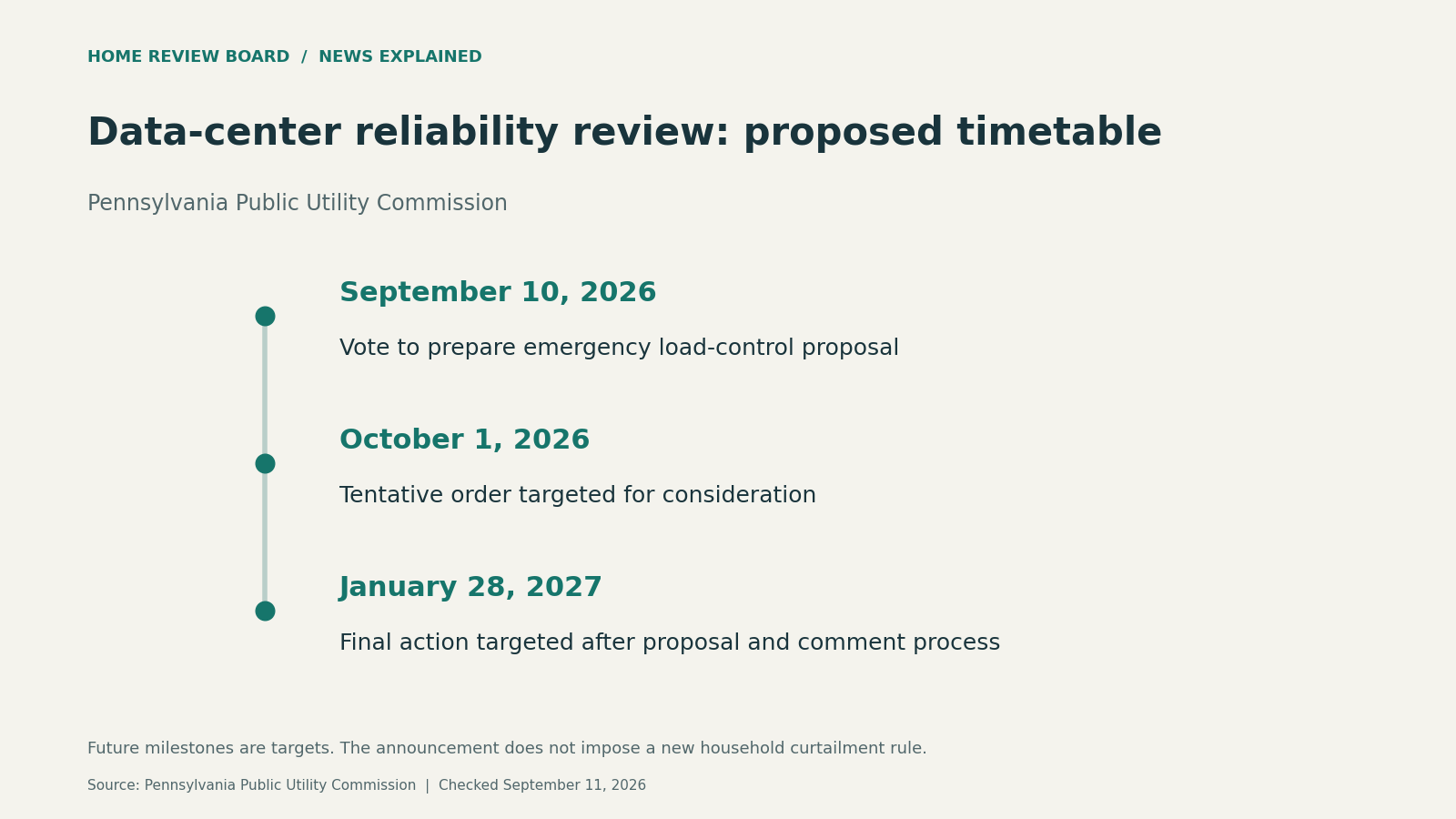
Pennsylvania’s Public Utility Commission moved on September 10 to examine how large data-center loads affect electric reliability and consumer costs. The unanimous vote directs preparation of an emergency load-control proposal and a technical conference, according to the Pennsylvania Public Utility Commission announcement. It sets a regulatory timetable rather than imposing a new household restriction immediately.
The commission expects to consider a tentative order on October 1. If approved, that proposal would proceed to public comment, with final action targeted for January 28, 2027. A technical conference is planned for the fall. These dates describe intended steps; they are not proof that a final rule already exists.
Separate a grid proceeding from a home assessment
For homeowners, the issue is consequential because reliability and the allocation of utility costs can affect ordinary customers. But the announcement does not predict an outage at a particular address or direct a household to install backup equipment. Those are different questions requiring different information.
Follow docket M-2026-3064961 for the actual proposal and participation details. When reading a later rule, look for which customers and facilities are covered, what triggers an action and how responsibilities are allocated. Headlines about large loads cannot answer those implementation questions by themselves.
A homeowner considering backup power can still inventory the loads that matter during an interruption and discuss them with an electrical professional. The resulting proposal should explain the intended coverage, limitations and project cost. It should not rely on an unverified claim that this proceeding makes a purchase mandatory.
A communication test for service businesses
Electrical contractors and HVAC companies may be asked whether data-center development changes a customer’s equipment plans. A careful response distinguishes the regulator’s stated concern from an address-specific finding. The existence of a policy review does not show that a service panel, generator or battery is suitable for the customer’s needs.
Businesses participating in the proceeding should document the practical question they want answered. For example, how will a proposal communicate obligations to affected users, and how will customers understand any costs assigned to them? Those questions can be evaluated against the published text when it appears.
The useful next step today is to record the proposed timetable and check the commission’s docket after the tentative-order meeting. Home project decisions should continue to rest on a written assessment and clear assumptions while the broader reliability policy remains under development.
Further reading
Electrical capacity before home upgrades and How to verify a contractor license.
Sources
Home Review Board publishes practical guides and source-grounded news. Project requirements depend on the property and location. Read our research approach.