
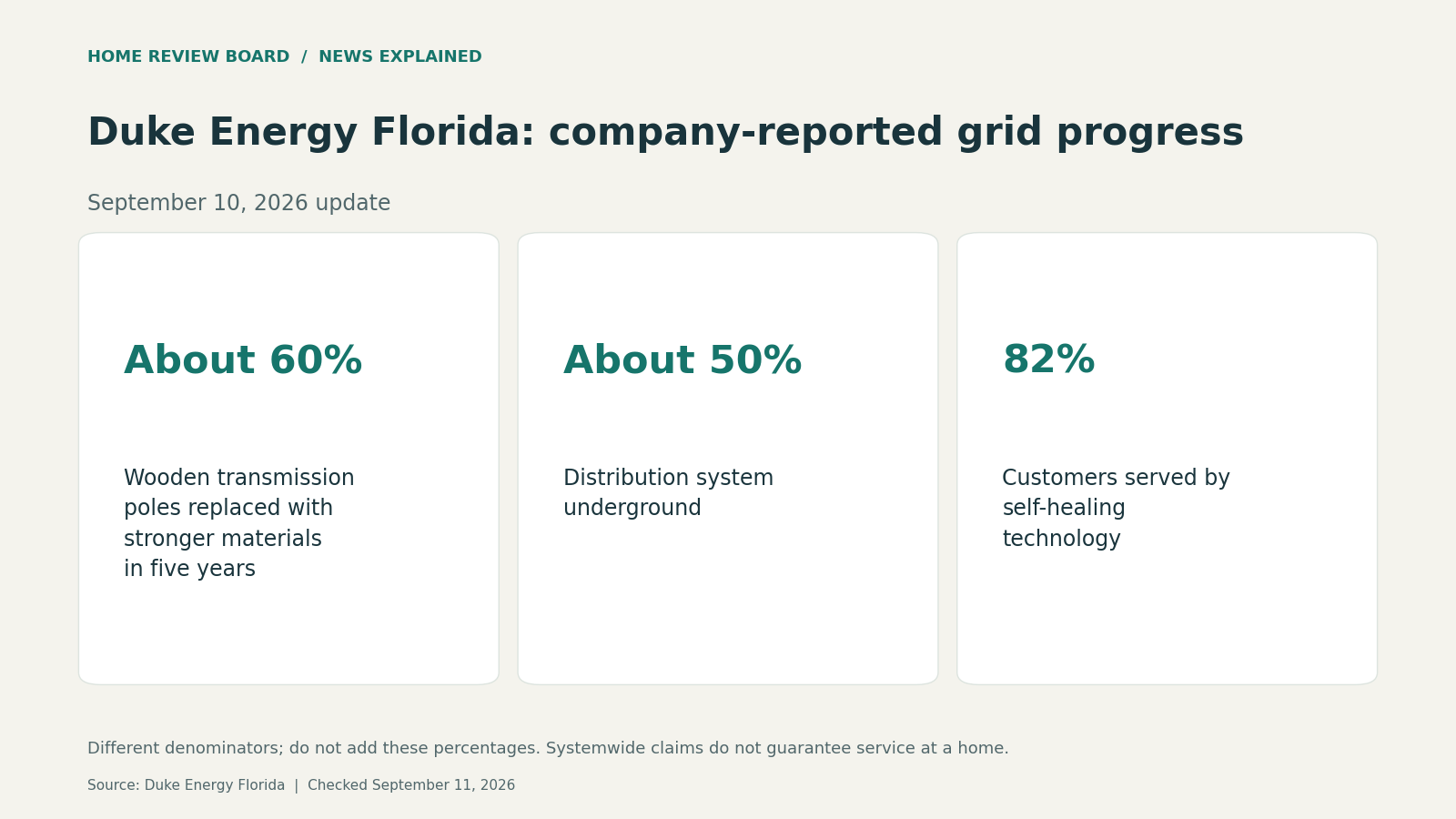
Duke Energy Florida used a September 10 update to report grid-hardening progress and ask customers to maintain hurricane-season plans. The Duke Energy Florida announcement says about 60% of its wooden transmission poles have been replaced with stronger materials over five years, roughly half its distribution system is underground and self-healing technology reaches 82% of customers.
Those figures are the utility’s own account of system improvements. They describe the service territory as a whole, not an independent assessment of a particular home’s outage risk. The announcement is also not a forecast of a named storm making landfall at a specific place.
Plan around the interruption you can manage
A homeowner can use the update as a reason to review the practical consequences of losing electricity: which household functions matter most, how communications will work and where existing equipment records are kept. The value lies in resolving those questions before a disruption makes scheduling more difficult.
If considering backup power, start with a clear description of the loads to be supported and the desired duration. Ask an electrical professional to explain the proposed system’s limits and the work required at the property. A general claim that the grid is stronger does not establish that backup equipment is unnecessary, just as a storm-season reminder does not make a purchase automatically worthwhile.
For projects already underway, discuss how a power interruption would affect access, deliveries and unfinished work. Keep the responsibilities in the project record. This is a coordination exercise, not a prediction that the utility’s infrastructure will fail.
Use resilience claims carefully in sales discussions
Electrical and home-service businesses should distinguish the utility’s reported upgrades from their own proposed work. A contractor cannot promise continuous utility service, and an equipment quote should not imply that every household in Florida is served by Duke Energy Florida.
The same discipline applies to estimated backup performance. State what the proposed equipment is intended to support and which assumptions affect that result. Give the customer a way to compare proposals using the same intended loads rather than competing headline capacities alone.
The next step is to check the actual electricity provider, review its current storm information and update the household’s outage arrangements. For an equipment project, seek a written assessment and a clear scope. System improvements are useful context, but the homeowner still needs a plan suited to the property and the people living there.
Further reading
Electrical capacity before home upgrades and How many contractor estimates.
Sources
Home Review Board publishes practical guides and source-grounded news. Project requirements depend on the property and location. Read our research approach.